History of the Importance of a Presidential Candidate’s Religion
Since it’s founding, America has never had a non-Christian president. All successful U.S. presidential candidates have identified with some form of Christianity, with the majority being Protestant. There has been diversity within the Christian faiths held the presidents, including various Protestant denominations such as Episcopalian, Methodist, Presbyterian, and Baptist.
The religious affiliation of presidential candidates has often been a topic of interest and sometimes controversy during campaigns. This has been particularly true when candidates belong to religious minorities or have non-traditional beliefs. Here are a few examples of how religious affiliation has been discussed during presidential campaigns:
- Al Smith (1928): Al Smith’s Catholic faith was a significant topic during his campaign. Anti-Catholic sentiment was prevalent at the time, and Smith faced strong opposition from some Protestant groups who were concerned about the potential influence of the Pope on American policy if a Catholic were to become president.
- John F. Kennedy (1960): Kennedy, a Roman Catholic, faced similar concerns about his religion. He gave a speech to address these concerns, affirming his commitment to the separation of church and state and asserting that his faith would not dictate his political decisions.
- Mitt Romney (2012): Mitt Romney’s Mormon faith was discussed during his campaign for the Republican nomination in 2012. Some voters had concerns about his religious beliefs, and Romney gave a speech addressing his faith and emphasizing his commitment to religious freedom and American values.
- Bernie Sanders (2016, 2020): Bernie Sanders, who is of Jewish descent, faced questions about his Jewish identity and his views on Israel during both of his campaigns. Some discussions revolved around his connection to Judaism and his positions on Middle East policies.
- Joe Lieberman (2000): As the first Jewish candidate on a major party’s presidential ticket, Lieberman’s faith was a topic of interest. While his faith was mentioned, it didn’t become a major issue in the campaign.
Religious affiliation can influence voters’ perceptions, and candidates often address their beliefs to allay concerns and emphasize their commitment to representing all Americans regardless of religion. In recent years, the focus on candidates’ religious beliefs has become somewhat less pronounced, reflecting changing social attitudes and a greater emphasis on diverse representation. However, it can still be a factor in some campaigns, particularly when candidates belong to religious groups that are less well-known or understood by the broader population.
In principle, the U.S. Constitution guarantees religious freedom and separation of church and state. This means that individuals of various religious backgrounds, or no religious affiliation at all, can hold public office and participate in the democratic process. However, in practice, candidates who openly identify with non-Christian or non-religious beliefs have faced significant challenges in gaining widespread support in presidential elections.
The first non-Protestant President of the United States was John F. Kennedy, who was elected in 1960. He was a Roman Catholic. Prior to Kennedy’s election, all the presidents of the United States had been members of various Protestant denominations. Kennedy’s Catholic faith was a significant aspect of his campaign, as he faced questions and concerns from some voters about the potential influence of the Catholic Church on his decision-making as president. His victory marked a turning point in American politics, as it demonstrated that a candidate’s religious background was no longer a deciding factor for many voters. Current President Joe Biden identifies as a Catholic.
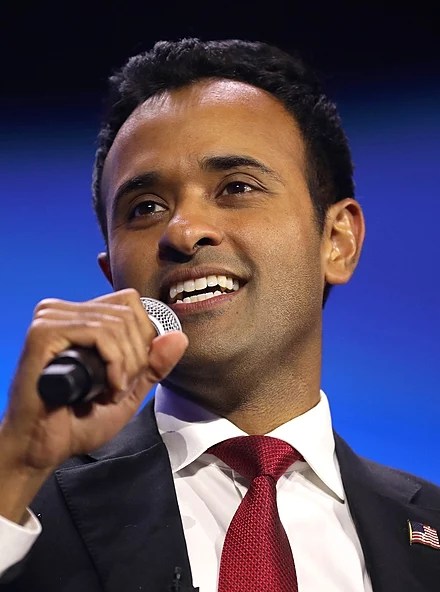
Whether America is ready for a practicing Hindu president remains to be seen. At the first Republican candidates’ debate of the 2024 U.S. presidential campaign in Milwaukee on Aug. 23, 2023, many people felt that he ‘won’. Others were not so positive. There is no doubt, though, that some Republican voters are starting to warm up to him. He has a way of saying what he thinks they want to hear.
It is interesting that Ramaswamy is doing so well at a time when America is becoming more friendly with India. India is a rising nation that is trying to play a balancing act between the US and China. It wants to maintain good relations with both countries, but it does not want to be seen as being too close to either one. India is also trying to promote its own interests in the Indo-Pacific region, and it is not willing to be a pawn in the US-China rivalry.
Who is Vivek Ramaswamy?
Vivek Ramaswamy, pronounced Vi-VAKE, is an ambitious, outspoken and intelligent American businessman, political candidate, political commentator. He is the author of three books that denounce the current culture and government. He is the founder and former CEO of Roivant Sciences, a pharmaceutical company. In February 2023, he declared his candidacy for the Republican Party nomination in the 2024 United States presidential election. Ramaswamy is a gifted writer and speaker and is able to articulate his ideas in a clear and concise way. He is not afraid to challenge the status quo. This has made him a popular guest on conservative media outlets, and it has helped to raise his profile among Republican voters.
Formative Years
Ramaswamy was born in Cincinnati, Ohio and his parents are from India. Ramaswamy had quite a few different worldview influences during his childhood in addition to his Hindu parents. From childhood to high school he was tutored in piano by a conservative Christian. Then he attended a Catholic high school. He has stated that he holds the same Judeo-Christian values as other Americans even though he is Hindu. He was also a member of the Jewish intellectual society Shabtai at Yale.
His personality as analytical, forward-looking, contrarian and bold became more obvious throughout his early adulthood. He graduated summa cum laude from Harvard University with a degree in biology in 2007. He then attended Yale Law School, where he was a member of the Yale Law Journal. After graduating from law school, he worked as a hedge fund analyst before co-founding StudentBusinesses.com, a technology startup company.
Career and Controversy
In 2014, Ramaswamy founded Roivant Sciences, a pharmaceutical company that develops and commercializes new drugs. Roivant Sciences has been successful in developing and launching several new drugs, including Vyondys 53, a treatment for Duchenne muscular dystrophy. Roivant Sciences did not actually develop any of the drugs that it commercialized. Instead, it acquired the rights to drugs that were in development or had been approved by the FDA, and then it created subsidiaries to develop and commercialize those drugs. Some have accused Ramaswamy of sketchy business practices.
One of the main accusations against Ramaswamy is that he used Roivant to engage in drug speculation. Drug speculation is the practice of buying and selling the rights to drugs that are in development, without actually developing or commercializing those drugs. This practice has been criticized by some for being unethical and for taking advantage of patients who are desperate for new treatments.
Another accusation against Ramaswamy is that he misled investors about Roivant’s financial performance. In 2020, Roivant reported that it had lost $1.2 billion in the previous year. However, some investors have alleged that Ramaswamy knew that the company was actually losing more money than it was reporting. Ramaswamy has said that Roivant’s business model was legitimate. He is being sued.
Ramaswamy is a vocal critic of what he calls “woke capitalism,” the practice of corporations using social justice rhetoric to promote their products and services. He is also a critic of identity politics, which he believes is dividing the country. He got both positive and negative attention for his 2021 book, “Woke, Inc.: Inside Corporate America’s Social Justice Scam,” in which he argues that woke capitalism is a form of corporate greenwashing that is used to distract from the real problems facing society. He also argues that identity politics is a form of collectivism that is antithetical to American values of individualism and merit.
My Comments
Any presidential candidate is going to be attacked by the opposition, within and without the political party, so it’s hard to know how much of the negative stuff being said about him and if these lawsuits are legitimate. But in my personal opinion, Vivek Ramaswamy is too young, too unproven, and too one-sided to lead this country. We need a president who will represent all people, for the good of America, no matter their personal views. It is unclear whether Ramaswamy is able to work with diverse groups in the mature and fair way that is expected in a free and equal society based on the Constitution. I do believe that his Hindu religion will be an issue for many Republicans, but not for all. Whether he will gain enough party support to get the nomination is a big question mark, but I would honestly not be surprised if he does. But I don’t think he can beat Biden, so I think that would be a mistake. I personally do not like that he was in the hedge fund and big pharma world as to me those are both pretty evil ways to make money. I am concerned that he may be too ambitious.
 Blue Skies and Green Pastures
I don’t think about religion as far as elected officials go. She doesn’t matter unless there’s clearly a missing of logic..
I’m not worried about religion and our presidents. I like how you said Joe Biden “identifies” as a Catholic, because he certainly doesn’t practice Catholic doctrine. One president to add is Richard Nixon who was a Quaker. As for Vivek, I’m impressed with him because of his intelligence and how articulate he is. I would hope he would surround himself with people with more experience in areas like foreign policy.
We heard some of what Vivek had to say a couple of months ago. It sounded intriguing, so we started doing some research into him as we do with all candidates. We are NOT impressed with his business history at all. His dealings with his pharma company raised some big red flags for us. We never even made it to his religious identity before deciding we will be looking for someone else to support 🙂 (And just in case anyone starts thinking that I’m saying we because I only vote how my husband votes, I say we because we research together, discuss together, and share our thoughts. We are not one in the same, I have my own opinions and I vote for who I believe to be the best candidate who aligns with my beliefs….which my husband and I share thankfully…) Sorry for the side note, just wanted to clarify 🙂 God Bless!
Good morning! My husband and I discuss candidates as well. Otherwise we are just canceling our votes! As for his past business, I’m not a fan . I’m actually still researching Ramaswamy . More to come!