In my last post I discussed the secret reason for inflation, which is that about 1/3 of the US population has enough money to easily buy things at current prices. This keeps demand high enough to prevent inflation from decreasing. In this post I will analyze another reason for high prices.
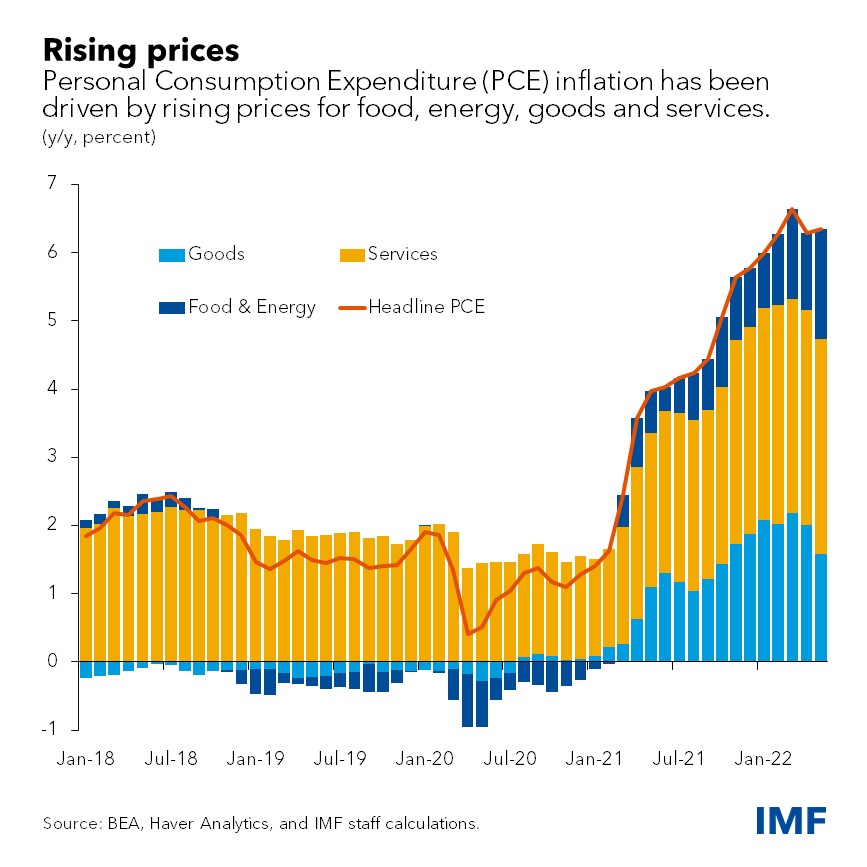
Although the increase in inflation was partly caused by flooding the economy with Covid stimulus money and supply chain problems, it wasn’t the only factor. The underlying ongoing problem is that our economy is changing and disproportionately affecting the middle and lower classes.
Capitalism is working
Capitalism is defined as an economic system where the means of production is privately owned rather than being owned by the public or government .
Wealth inequality is actually a sign of the success of Capitalism. Capitalism is supposed to enable people to get rich and it is working.
Just because you live in America doesn’t make you a capitalist. You are likely a worker or small business owner who buys your supplies from a capitalist. The true capitalist is whoever owns the basic materials or resources that are necessary to do business, which includes things like factories, currencies, fuel, lumber, metals, office buildings and political power.
They also largely determine the prices of the things you sell and the wages you earn because they set the prices for the materials you use. There’s some price variability depending upon what the buyer is willing to pay, but to make a profit you can’t sell for less than it costs you to provide it. That’s just basic math.
Most small businesses resell goods bought from someone else. If you own a restaurant, you buy your food from a supplier who buys the food from a food company. We discovered during Covid that most of our prescription drugs are made in other countries! And we learned that computer chips are an essential component of life that we need to produce in America.
However, if you own chickens and they lay eggs and you sell them, you are a capitalist! Good luck making a profit though unless you figure out how to feed them cheaply. Because the one who sells the chicken feed is making the real money.
Farmers are losing the economic battle
Farmers are business owners who have a lot of upfront costs and risks. And most farms are privately owned, but they are struggling due to being highly dependent on food company contracts to sell their products and the use of fertilizer which greatly influences their profits. They have costs such as property taxes, expensive equipment, and seeds. They’re also at risk of crop failures due to weather and insects, as well as being at the mercy of the commodities market.
In recent years, the profitability of farming in the United States has declined. This is due to a number of factors, including the rising cost of inputs, the decline in commodity prices, and the increasing consolidation of the agricultural industry.
Farmers are losing more money than they are making, while big food continues to thrive. According to a report by the American Farm Bureau Federation, the average U.S. farm lost $3,500 in 2022.In contrast, big food companies have made big profits in 2022. According to a report by the Wall Street Journal, the top 10 food companies in the United States reported profits of $110 billion in 2022, an increase of 10% from 2021.
The Land of Opportunity?
But isn’t America the land of opportunity and a free market economy? Don’t people come here from all of the world seeking a better life? It’s true that in America almost anyone can start a business if you know how and have the resources. You have the freedom to sell products and services with the goal of making a profit. However, simply owning a business doesn’t mean you will make a profit, for the reasons mentioned above. You’ll have to be able to sell at a price above your cost.
There are many hurdles that must be overcome to becoming a successful capitalist such as licensing, permits, regulations, taxes, and financial risks. But if you have the startup resources and business skills and patience and innovative ideas, you could make a lot of money like many people in America and other countries . Even China and Russia allow their citizens to own private businesses now, but I’m not sure where they get their goods. Remember it is the one who owns the means of production who is the capitalist.
The CCP maintains that despite the co-existence of private capitalists and entrepreneurs with public and collective enterprise, China is not a capitalist country because the party retains control over the direction of the country, maintaining its course of socialist development.[1]
Wikipedia
The Challenges for Capitalism in the Future
In the future, the WEF predicts, people will “own nothing”. I’m not sure how “happy” they will be. The probable scenario is that the labor class will rent everything from the capitalists and will own nothing because the prices prohibit actual ownership. Workers who would have owned a home in the 60s are being forced to live in crowded cities in multi family housing due to the lack of affordable housing . This is because demand is high for houses that many people cannot afford. Builders say they can’t build affordable housing because of the cost of materials and labor. Housing advocates say the only solution is government subsidies.
Capitalism has been working so well that the standard of living has increased more than the middle and working class can currently afford. Americans expect more than the bare necessities of minimal food, basic clothing, and shelter such as the poor are happy to have in developing nations. Our education system and political parties have made big promises to the poor and middle class that are getting less likely to be fulfilled by the current economy.
Middle class Gen Xers who improved their financial status relative to their parents often find their own children are unable to buy houses or find stable employment. Is this because these parents did not raise their kids right? Or is it due to a lack of middle class jobs? Data shows that those jobs are disappearing. Economists and politicians have known this was coming for a long time. It is a direct result of globalization and the technological changes on the economy.
The recent trend in job polarization raises the possibility that gains in well-being that come from productivity improvements will accrue to an economic elite. Perhaps the middle-class affluence that emerged during the latter part of the industrial age is not going to be a feature of the information age. Instead, we could be headed into an era of highly unequal economic classes. People at the bottom will have access to food, healthcare, and electronic entertainment, but the rich will live in an exclusive world of exotic homes and extravagant personal services. The most popular bands in the world will play house concerts for the rich, while everyone else can afford music downloads but no live music.
https://www.aei.org/articles/what-if-middle-class-jobs-disappear/
Interestingly, when I was researching inequality for this article, I found a very similar analysis of the changes in the economy on the World Economic Forum website. The WEF is also a major contributor to the lack of jobs because they have been pushing digitization and UN SDGs. However, their solution to the challenges is more fascism, not less. They are perfectly fine with having all the means of production in the hands of a few mega-corporations. Rather than address the systemic issues caused by politics, excessive regulations, globalization and technology, which the government helped create, they plan to redistribute the incomes of the upper-middle class to fund the lower middle class.
What is the solution? I don’t really know. I am not in favor of more taxes, redistribution through UBI or public-private partnerships, but something has to give. If nothing changes, I foresee a revolution which will usher in even more tyranny and an economic crash even worse than the Great Depression.
Maybe we need more capitalism. More private people owning the means of production would even out wealth inequality. One way to achieve broader ownership is to help people learn how to invest their money in other companies and teach entrepreneurship in high schools. Another measure would be to break up the monopolies. And there needs to be a market available for those in the lower income bracket. I see a big opportunity for innovative capitalists who will find a way to provide cheap housing, cheap food, and cheap cars for the working class. New tax laws, business financing and credit arrangements may be necessary, but it can be done. Otherwise America is going to look very different by 2040.
 Blue Skies and Green Pastures
This is a great blog post. It is relevant and important. You don’t vent about Democrats, Republicans, city dwellers, the 2nd Amendment, public schools, Bud Light, or Ukraine. Most people can’t resist doing that. It’s a distraction!
Good quote from AEI. They understand, i.e. that the gap between a few very very wealthy and The Rest Of Us will be so huge that the two groups will have lives unrecognizable to each other. And that soon, The Rest Of Us won’t have access or seed capital to make our lives better through hard work. About housing: Yes, America is becoming a nation of renters. That’s bad, because having no choice other than paying rent makes people vulnerable. After a mortgage is paid off, you own your home and land. That’s why I don’t like the “gig economy” either: You own NOTHING and only the WEF is happy. You said this:
It isn’t necessarily the builders’ fault. They can still build some affordable housing, although not as much now since inflation and sourcing from overseas makes materials and labor more expensive. Here’s the problem: Few new houses and even fewer existing houses (there are a lot of them, built 10 to 50 years ago, and still in decent condition) ever make it on to the real-estate market. Here’s why: After the financial crisis in 2008-2010, Wall Street speculators (e.g. AIG) were bailed out by us. Not one went to jail. Most lost some money but still had a lot. And they wanted to make more. There weren’t many opportunities because it was a recession. So the same investment bankers and very wealthy people had the idea of buying homes for sale, and if necessary, paying to fix them to be livable. As the economy improved, they also bought new homes, straight from builders. The investor groups spent many millions of dollars. Next, they rented the houses. They often expect the renter to do repairs, and evict really fast. Local temp workers do the for-rent ads and collect rent. The houses aren’t rent-to-own.
By 2019, investor groups owned most of the housing stock in the southeast US, and have since expanded further north and west. This isn’t a conspiracy theory! Bloomberg and The Wall Street Journal report about it. I can give you links to articles if you want. Housing subsidies would be giving money directly to Goldman Sachs and Alden Capital! (They led this mass house buying business, but others started doing it too.) It isn’t capitalism’s fault per se. No one did this in the past even though they could have. It is motivated by the worst sort of greed. And it is short-sighted.
There’s a solution. I don’t like government interference, but the Consumer Financial Protection Bureau (CFPB), the IRS, and the SEC (with help from Congress) could make it illegal. Then the housing private equity investor groups (usually a few dozen people, but some own 100,000 or even a million homes) couldn’t buy houses. Maybe tax laws could be changed too, so that they would start selling the houses they already own.
There’s another problem: Many of the people with the most authority at the CFPB, IRS, SEC, and in Congress are either investors themselves (or have family members who are), or accepted election campaign contributions from these investors, or know it would be difficult to implement because the housing investor people have so much influence. There’s a term for it: REGULATOR CAPTURE. I don’t have an answer to that.
P.S. Sorry for my long comment! I’ll post it on my own blog and link to you if you decide to reject it.
Thank you and I agree that laws preventing this type of thing are desperately needed, but who is going to make them when the lawmakers are benefiting from the problem? It’s a bad situation. Someone will have to sue someone and start the ball rolling to the Supreme Court . I appreciate the input .